





Inflation
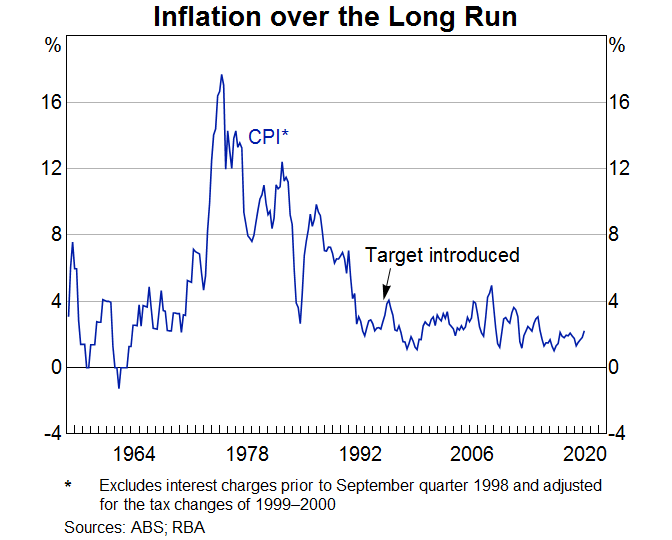
The most recent rate of inflation in Australia holds at 3.6 percent as noted in the second quarter of the year 2011. Since 1973 to date, the average inflation rate has been 6 percent. A record high of 17.6 percent was noted in 1975 and a record low of -0.3 percent during the year 1997. Inflation here refers to the rate of measured rise in prices when compared with standard levels of purchasing power set within a given country. The most commonly known measure of inflation is the Consumer Price Index that analyzes consumer prices in the market, and the Gross Domestic Product deflator that measures inflation in a macro-scale within a given economy.
Retrieved from http://www.tradingeconomics.com/australia/inflation-cpi
Rises in inflation rates in Australia were mostly influenced by an increase in the prices of basic commodities like motor oil, medical services, loan, deposit facilities and fruits. However, in the same period, other commodities were used in offsetting the harsh conditions. These included items like, electricity, audio, visual and computing devices and milk. Another cause of inflation was the cost-push aspect evidenced when costs of most goods were passed onto the Australian consumers causing enhanced prices in all commodities. The heightening was actually caused by an increase in costs of important commodities like oil, labor, interest rates, importation prices and the devaluation of the Australian currency.
Excessive demand for goods and services in intensities exceeding their supply also caused inflation. This is because the unmet demand led to the increase in prices of rare goods and services that had then to be reflected to end users. Subsequently, too much money was used in purchasing very little goods. The rise in oil prices in particular caused the bulk of inflations in Australia. This is because the oil price increments meant that proportional cost enhancements would also be noted in items like petrol and other fuels. In addition, most manufactured items and commodities needed to be transported using fuel in trucks or ships. Also, note that raised oil price also affected jet fuel in a similar manner hence imparting more overheads in traveling and transporting needs. In the end, these costs had to be translated to all consumer purchases.
Inflation and inflationary forces might be unseen to consumers as prices increase merely by cents in most instances since eventually in a few months a consumer might have increased their spending by one percent, and thus marking inflation. A tight monetary policy is an action taken by the Federal Reserve Bank of Australia towards constricting the amount of money spent in the Australian economy. This is because once the economy is identified as growing too quickly a need to curb inflation arises. The reserve bank makes money flows tight by raising interest rates on short-term borrowing and therefore shifting the same cost to borrowers. Eventually, this discourages people from loan acquisitions and reduces the amount of money circulating in the nation.
Some of the measures taken in a tight monetary policy include the selling of treasuries in open markets to absorb extra capital. This also reduces monetary levels in circulation by sourcing excess money from consumers by absorbing them in financial reserves. Financial sellers are attracted to such federal bank offers by the guaranteed banking payments. A tight monetary policy is usually implemented in times when there is a strong economic for strengthening purposes.
Similarly, a fixed exchange rate can be used by government or the central bank towards maintaining constant and official exchange rates that need to be determined against other major world currencies like the U.S. Dollar and the Euro. In this approach, the central bank purchases and sells its own currency in the money market and in return, it receives the currency that has been used to set the exchange prices. For instance, if the Australian Reserve Bank determines that the exchange rate of a single unit of its own currency is equal to two dollars, it has to ensure that it can supply its financial market with dollars.
Moreover, in order to maintain the rate at this price, the central bank must keep a high level of reserves in foreign exchange. The reserve will act as backed foreign currency that will be held by the central bank of a country until it is released or absorbed in terms of funds within various trading markets. This in turn ensures that the money supply, the market fluctuations in terms of inflation or deflation and the exchange rate are well instituted.
Retrieved from http://www.rba.gov.au/monetary-policy/images/inflation-long-run.gif
Retrieved from http://www2.hmc.edu/~evans/chap2.pdf
Use the order calculator below and get started! Contact our live support team for any assistance or inquiry.
[order_calculator]